Friday, August 5, 2016

Artikel-platforms komen en gaan


Mijn eerdere artikelen over artikel-platforms verdienen een kleine update: zoals al gevreesd is eind juli ook eLinea failliet gegaan. De site blijft operationeel in de hoop op een doorstart.


Deze “Spotify voor artikelen” bood flat-fee toegang tot een heel brede collectie aan periodieken, maar wist de dagbladpers nooit aan zich te binden.

Eigenaar Michel Suijkerbuijk wijt het bankroet in VillaMedia aan het gebrek aan marketing c.q. marketingkapitaal, iets waar Blendle veel beter in is gebleken.

Paper en Topics

Ondertussen is de dagbladpers zelf ook met artikel-platforms bezig. Het in 2015 gestarte Paper Magazine biedt 15 geselecteerde hoofdartikelen per dag voor € 6 per maand – zonder toegang tot meer. Vooralsnog lijkt het geen doorslaand succes.

Sinds kort kunnen abonnees van de 4 grote landelijke titels van De Persgroep ook gratis toegang krijgen tot de overige titels en artikelen van De Persgroep via Topics. Topics doorbreekt de beperking tot één krantenlabel en ontsluit nieuwsartikelen op een meer thematische manier.

Het gratis “verdienmodel” is natuurlijk erg interessant voor de lezers, maar het bereik blijft vooralsnog beperkt tot de eigen titels van De Persgroep. Of dit genoeg is om te floreren of te overleven? Wordt vervolgd…

Friday, April 1, 2016

Artikel-platforms – 2 jaar verder

Twee jaar geleden schreef ik een blog over artikel-platforms. Van de 4 besproken platforms ging MyJour naar eigen zeggen gisteren op zwart (alleen is iemand gisteren vergeten een stekkertje eruit te trekken). Tijd voor een korte update.


Exit MyJour

MyJour geeft zelf aan dat het niet lukte een succesvol verdienmodel neer te zetten. Iets waar Blendle ook niet in slaagt, maar wel voldoende investeerders wist aan te trekken.
Volgens MyJour oprichter Verheul is de keuze van Blendle om zich op journalisten en mediabedrijven (en hun bereik) te richten achteraf beter gebleken dan de keuze voor een uitgever-oriëntatie van MyJour.

Waarom wint Blendle (voorlopig)

De NRC noemt ook 5 lessen uit deze strijd: Investeerders, Bereik, Verdienmodel, Marketing en Onmisbaarheid.

Persoonlijk denk ik dat meespeelt dat Blendle (en eLinea) een veel betere User Experience wisten te bieden dan MyJour, en daarmee een grotere schare gebruikers wist te binden die trouw bleven en dus ook bleven betalen. In mijn vorige blog noemde ik dit curatie – iets waar Blendle m.i. goed op heeft ingezet.

De toekomst

Dat vier soortgelijke platforms naast elkaar overkill was is niet zo vreemd. Of eLinea het nog lang volhoudt naast Blendle – we zullen het zien. Het NRC artikel noemt ook voor Blendle een aantal gevaren c.q. noodzakelijke doorontwikkelingen.

Dat Artikelgemist.nl nog bestaat wil ik een klein wonder noemen, ik vind de User Experience dramatisch. Lage kosten en hoge marges op kleine omzetten houden het wellicht nog lange tijden in de lucht.

Monday, March 21, 2016

Should you date your content?

Repost from my Tahzoo Blogpost:

More and more it seems, online publishers (yes, you are a publisher) are publishing content without showing a (prominent) last-modified date. Why is that? And, more importantly, should you follow suit?


Why hide the date?

Without asking each and every one for the rationale behind this choice, I can make an educated guess:

For most readers, the date strongly indicates the content's relevance. If you are doing online research, would you take the time to read a SEO piece from 2013? Would you read any Social Media piece from 2014? Probably not.

The last few years, large groups have joined the Content Marketing movement—and rightly so. The Content Shock (full disclosure: published in 2014) has forced anyone doing serious online research to excel in content curation: weeding out the irrelevant from the excellent in seconds.

On search, Google will try to show the publication date of your content in the result list. Google will show the Title, URL, Date and a (Rich) Snippet, and the reader will use all that to rank the results:


Figure 1. If you are researching CMSes, which would you open?

It doesn’t seem like Google puts a big penalty on not having an (explicit) date, or on aging content, which is a bit strange to me: I have tweaked SOLR searches and usually the date weighs heavy in the relevance score.

But your content is evergreen, and time will not wither away its brilliance? Hiding the date from your publication could help you retain traffic to your hard-earned jewels.

Your implicit promise

Removing dates from your content prohibits me from using its age to ascertain its relevance. You, as a publisher, are making me, the reader, an implicit promise that I will not be disappointed in the timely relevance of your content.

This is a promise that is hard to uphold. Do you check your old content for relevance? Do you update your content to remain relevant? Do you unpublish aged content?

Having implemented many CMSes at a diversity of large content organizations, I know that this is rarely the case. The processes are not in place to do so, and the tools to support such processes are usually poor.

So: To date or not to date?

So, it could be that you are that one writer that keeps all your content crisp. Brilliant! I want to read! In that case, use your last-modified date to show me your hard work.

Do you fire and forget? No problem! Also put include your last-modified date—which will be equal to your published-on date.

Does your content have an extended shelf life? Kudos to you! I hope you have (or build) a reputation for this. I personally have no problem in sharing wayback content from big names—although they will have probably produced something better already.

If you want to provide relevant content to your readers, show the last-modified date. And set it at the beginning of your content so Google and your reader can use it. Google will help you here, because it puts greater value on the last-modified date than the published-on date.

Reading on?

Here's a nice read on experimenting the use of dates: Should You Remove the Dates From Your Blog Posts? (2013) Somebody was sorry sharing a 5-year-old piece, without considering it could still be relevant.

Do read the discussion section, including where they say that Twitter users hesitate to tweet anything over 14 days and make other good points about why to not date your content. Usually, it boils down to the “image” of the publisher. Relevance is in the eye of the reader.

Friday, February 5, 2016

De beste Content Marketing van 2015?


The Content Strategist heeft een top 10 met de beste Content Marketing van 2015 opgesteld.
De lijst is een interessante mix van “klassieke” Content Marketing, ruim uitpakkende video marketing en content waarbij de relatie met het merk juist heel dun geworden is.


The Message

Volgens The Content Strategist was “The Message” podcast de beste Content Marketing uiting van 2015. Een mooi gemaakt verhaal waar de naam van GE niet opvallend in voorkomt.

Is dit nog Content Marketing, als het lijntje zo dun wordt? Of is dit een goed signaal: goede content zonder een dikke klodder reclame?

Monday, January 18, 2016

Planned serendipity

Repost from the Tahzoo Blog:

A recent podcast from “This American Life” told the story of a New York literature professor who set a goal to read one shelf of books in her local library. She wanted not just to experience the jewels of the library, but also the average, or even the mediocre books, too. In her quest, she discovered some unknown treasures. This kind of “planned serendipity” stuck in my mind.


Serendipity in CX

As customer experience (CX) experts, Tahzoo tends to focus on patterns: related products, related content, “Customers Who Bought This Item Also Bought” kinds of things. We measure, segment, do predictive analysis, and base our personalization on these steps. Usually, we’re right on target.

But aren’t marketing-driven personalization engines killing diversity? Recommendation engines aren’t really that random; usually they are a list of similar items sorted by some function of probability of you—the customer—liking the item.

In one of my previous projects on accessing news articles, the serendipitous finds were often the most interesting ones. We enriched news articles through entity recognition. Entities came from sources such as DBPedia, Freebase and Geonames. With any article or entity we showed related articles and related entities. General news we tend know, so these relations were easily ignored. The unexpected links were by far more interesting—and possibly more valuable.

The same holds for my personal newsfeeds: Who hasn’t blocked Buzzfeed and similar from their timelines? All in favor of the hidden gems, curated and endorsed by your friends and peers.

Business examples

In business, serendipity has often played a big part in the success of startups. Muller & Becker wrote Get Lucky on setting the right skills to seize creativity and unplanned events. So, serendipity and business really do belong together.

CX examples

Just how happy is the union of serendipity and CX? Well, like many marriages, it has been tried with to varying success:


  • Stumbleupon tries just that, with tools to manage your serendipity (now that is a real oxymoron). SU started in 2002 and thrived for years but seems to be struggling now.
  • Random is an app that tries to serve a combination of relevant serendipitous news. It seemed to be going strong, being backed by Skype founder Janus Friis.
  • Wikipedia includes a Random article on its homepage. How often do you hit it?
  • Dating is all about serendipity, so for instance Happn uses it in its approach.
  • The short-lived photo-sharing App Rando was not only labeled serendipitous but even antisocial for going against mainstream orchestrated and “like”-driven channels.
  • The Highlight App seems to survive, whereas the Roamz App has already kicked the bucket.
  • Spotify offers a serendipitous function: It plays a few seconds of songs that have been played simultaneously by two people in different locations on the planet (audio alert, and this is not a playlist).
  • Google worked on a “Serendipity Engine” for years. Is Google Now the end result? Google Now is an App that pushes you information, based on your agenda, location and preferences without you requesting for it.
  • For more examples read Sarah Perez’ TechCrunch article on Engineering serendipity.

Making serendipity work 

From the above examples it looks likes serendipitous functions haven’t been a resounding success. So are there any tricks to make serendipity work for you?

One of the Roamz founders says that you need to have a strong primary product, where you can add serendipity. Serendipity by itself is not a killer feature, but it adds strength to an already strong proposition.

Kiip seems to succeed by capitalizing on “serendipitous moments” by choosing the right time to make an offer, thus conversion ratios can soar. This success is all about choosing the right moment, and by introducing a random factor, a real serendipitous experience is created.

Lastly, to achieve serendipity, you need access to (multiple) data sources that somehow gauge the users’ sentiment. You need to reach them at the perfect, happy moment or otherwise make serendipitous combinations the users cannot make themselves.

Your result list should really be A/B tested— A) with and B) without the serendipitous find. That is the only way to really know that ‘serendipity’ is a better experience.

Managing serendipity 

Add a touch of serendipity to your CX, so your users feel pleasantly surprised by your offers, rather than feeling they are being funneled. Let your UX team be creative, but let the data team make it relevant and productive.

PS: For a regularly dose of serendipity, visit the Tahzoo blog. Better yet, follow it.

Wednesday, December 23, 2015

In Social Media: Earn, then Own

Repost from the Tahzoo Blog:


In the past few months, some subtle and some not-so-subtle changes have happened in the social media landscape.  Together, I think they teach us a lesson on dependencies that could—or should—influence your Marketing Technology choices.
social media by Sean MacEntee 

TWITTER

On November 20thTwitter disabled the Tweet count feature. As explanation, Twitter provided a dominantly technical and partly functional response, but left the community guessing as to the business reasons. Access to Tweet count remains possible only through a paid API. It’s not a dramatic change, but if Tweet count was part of your KPIs, I hope you reserved some budget for a fix.
Of course you should keep using your social media channels for your Content Marketing efforts, but business-critical data should be housed in your own analytics platform, not on rented land.

YOUTUBE

With the launch of YouTube Red on October 28th, YouTube offered partner creators a new revenue-share deal. All of the major content creators have been given the choice: accept the new deal or have your content made private.
This could very well be a sweet deal for the content creators, but it is still unclear what cut the creators will get and what the results for paid and ad-supported channels will be, but I do not think the content creators were altogether happy with this unilateral change. ESPN had to remove a large part of its content, not being able to meet the new conditions.
There’s a big chance you won’t be affected by this change, but it leaves us questioning what YouTube/Google’s next change will be. Will that effect you?
YouTube remains an attractive channel to stream video, but if videos are becoming a growing part of your Content Strategy, consider hosting your own videos and be liberated from conflicting ads and other restrictions on YouTube.

GOOGLE+

Google+ has been pushed by Google since 2011, but this year Google+ was abandoned as the Google Identity framework and updated last month to the revamped Google social network. Whether it will take off now is anybody’s guess as it is not part of the Google package deal anymore.
Change is unavoidable, but we must be in control of how we interpret change. And we should be able to react to change fast to seize new opportunities. Perhaps building a Google+ Community or Collection now is your next big thing. Or, perhaps, it isn’t.

FACEBOOK

In the last two years there has been much upheaval about the algorithms Facebook uses to filter your feed. Just search for “Organic Facebook Reach” and you will understand. Facebook offered explanations, but left lots of users baffled or angry, seeing organic reach drop by 50% or more.
So what can you do besides pay for the reach you once got for free? Unlike SEO, FTO (Facebook Timeline Optimization) seems to be the new science. The best overall advice is to do your own multivariant testing, and discover what works for you and your fans.

WRAP-UP

The best advice is to keep earning your audience. Keep distributing your story through your favorite social channels, and engaging potential customers in the process. Get new people into your CRM system so you can reach out to them in a personalized way should be your main objective. And, last, make sure you own all your important content, and distribute it over channels you control. Don’t build your house on rented land!
And, finally, build in the flexibility to change – you will need it!
If you are interested in finding out how Tahzoo can help you adapt to these and other change of the age of digital transformation—perhaps with a free evaluation of your present situation—let us know. We would love to help.

Friday, December 11, 2015

Serial season 2

I am thrilled to see that Serial season 2 has kicked off.
Serial is a podcast from the creators of This American Life, and tells one true story over the course of a season.


I loved Serial season 1 (review in Dutch). I loved the intriguing plot, the art of storytelling, the great soundtrack, the podcast format and the innovative business model supporting it.

I hope season 2 will thrill me (and you) as much as season 1 did.

Tuesday, January 13, 2015

Getting started with Semantic Technologies

Recently Ontotext launched a Self-Service Semantic Suite – shorted to S4. S4 provides a set of services for low-cost (currently free) on-demand text analytics and metadata management on the cloud. This provides a great way to get acquainted with Semantic Technologies.


Available S4 services

S4 currently offers the following services:

  1. Text analytics for News content, Biomedical content or Twitter content
  2. Linked Data server with reliable access to the DBpedia, FactForge, GeoNames, WordNet, MusicBrainz, and New York Times datasets 
  3. Self-managed RDF database (GraphDB) on the cloud

Trying out Text analytics

Text analytics – in this context – is about finding out what is important in texts (natural language), and using this information.

To try this out, copy some text containing some Persons and Places, biomedical terms and/or Twitter content. Preferably in English for best results, but other languages will produce results as well.
Go to the S4 homepage and click on “Demo S4 today for free”. Paste your text in the Text Analytics box; choose whether your text is more News, Biomedical or Twitter oriented, and hit Execute.

Your result will show the provided text with different types of terms highlighted in different colours. See the below example.


Figure 1. Example of an annotated text

If you hover over an annotated term, it will show extra information. For instance for an organisation it will show the location in DBpedia (the semantic version of Wikipedia). In my example this makes clear that this article is not about some IMF, it is about the IMF, and more info is available on http://dbpedia.org/page/International_Monetary_Fund.

So what’s in it for you? 

This service can provide all kinds of structure and information on topics that can help you to classify, understand, link and enrich information.

Trying out Semantic queries

S4 also lets you try out semantic queries using SPARQL, the query language for semantically stored information such as the DBpedia.
Go to the S4 homepage and click on “Demo S4 today for free”. Go to the LOD Access Tab. Select a query from the Pulldown. Let’s try “Find airports near London”.
The SPARQL query is:

PREFIX geo-pos: <http://www.w3.org/2003/01/geo/wgs84_pos#>
PREFIX omgeo: <http://www.ontotext.com/owlim/geo#>
PREFIX dbpedia: <http://dbpedia.org/resource/>
PREFIX dbp-ont: <http://dbpedia.org/ontology/>
PREFIX ff: <http://factforge.net/>
PREFIX om: <http://www.ontotext.com/owlim/>

SELECT distinct ?airport ?label ?RR
WHERE {
        dbpedia:London geo-pos:lat ?latBase ;
                       geo-pos:long ?longBase .
        ?airport omgeo:nearby(?latBase ?longBase "50mi");
                 a dbp-ont:Airport ;
                 ff:preferredLabel ?label ;
                 om:hasRDFRank ?RR .
      } ORDER BY DESC(?RR)


Even without a SPARQL crash-course, this is quite easy to read:

  • First some definitions are introduced
  • The query will return the airport ID, name and some rank (RR)
  • From DBpedia the latitude and longitude of London are retrieved
  • Only results that have the DBpedia Ontology type “Airport” are selected, 
  • They must be nearer than 50 miles to London, according to the Owlim Geospatial function “Nearby”

Click on “Execute” and have a look at the results. Try out some of the other queries as well.

So what’s in it for you? 

An enormous wealth of structured information is available for you to use. Were you aware that you could ask Wikipedia such detailed questions? Be aware: extensive knowledge is needed to write such concise statements and really use the results.

Next step

Now that you know that Text analysis and Semantic queries are available, what is your next step in using Semantic technologies?

Saturday, December 20, 2014

Serial – een geslaagde contentstrategie

Zojuist is het laatste deel van Serial gepubliceerd. Serial is serie van 12 podcasts van de hand van Sarah Koenig en geproduceerd door This American Life van WBEZ. Het volgt het onderzoek van Sarah naar een moordzaak in 1999. In 12 afleveringen wordt het verhaal verteld van de moord op Hae Min Lee in Baltimore, de veroordeling van Adnan Syed voor deze moord en het onderzoek naar het bewijs – 15 jaar later.


Na aflevering 1 was ik direct verslaafd. Het plot is intrigerend: een ontkennende verdachte, veroordeeld op uiterst dun bewijs dat op veel plaatsen elkaar tegenspreekt. Daarnaast nemen Sarah Koenig en haar team de luisteraar mee op hun zoektocht vol twijfel, verbazing en soms zelfs humor.

Wat zijn de aspecten die Serial in mijn ogen bijzonder maken, en wat doet dit verhaal in een Blog over voornamelijk de technische en business aspecten van contentstrategie?

Serial en contentstrategie


Iedere content strateeg kent inmiddels het belang van een goed verhaal, en dit is een goed verhaal. Niemand begrijpt hoe de zachtaardige 17-jarige Adnan zijn eveneens 17-jarige ex-vriendin heeft kunnen vermoorden, maar hij is er wel voor veroordeeld, ondanks soms flinterdun bewijs. Het interessante verhaal plus de persoonlijke – haast intieme – manier waarop het verteld wordt zijn voor mij de eerste stap in deze geslaagde contentstrategie.

Een tweede stap is de aandacht die in deze productie is gegaan. 15 Maanden onderzoek van een compleet team van journalisten heeft geresulteerd in 12 podcasts van ieder ongeveer een uur non-fictie radio. Het dichtste wat erbij komt dat ik ken is Argos radio – maar dan maatje XXL. Er is een eigen website met ondersteund materiaal en er is zelfs speciaal een eigen soundtrack gecomponeerd door Mark Henry Phillips en Nick Thorburn.

De derde stap is de – voor mij – ideale kanaalkeuze. Ik zit dagelijks twee uur in de auto, en een uur Radio 1 is echt genoeg per dag. Podcasts zijn voor mij ideaal omdat ik kan luisteren naar de dingen die mij interesseren: Argos, de Content Matters Podcast en vele anderen, op het moment dat het mij uitkomt.

De vierde stap in deze geslaagde contentstrategie is het commerciële aspect. De eerste podcasts worden betaald door het WBEZ radiostation, gesponsord door MailChimp. In opvolgende podcasts hoor je extra sponsors aanhaken, aangetrokken door de kwaliteit en/of het succes van de podcast. In één aflevering doet Sarah Koenig een oproep voor de financiering van een tweede seizoen. Deze financiering is binnen een week rond.

Ook ik heb een kleine donatie gedaan aan Serial. Het blijft raar dat ik zonder knipperen 20 euro neertel voor een nieuw goed (e-)boek van mijn favoriete auteurs, maar twijfel over het doneren van een paar euro na het gratis krijgen van een fantastisch audioboek van 12 uur.

Conclusie


Mijn doel van deze blog was om te vertellen over hoe ik genoten heb van deze fantastische podcast, en is dat niet het bewijs van een fantastische content strategie? Gratis Word-of-mouth marketing. Doel bereikt met vlag en wimpel! Ik wacht geduldig op seizoen 2 van Serial, of vergelijkbare initiatieven.

Vertel een goed verhaal, zorg dat het kwalitatief goed gemaakt is en in een handig formaat. En laat de credits (in welke vorm dan ook) binnenstromen. Dat geldt voor elke goede contentstrategie.

Friday, November 21, 2014

Big improvements for Big Content


At HintTech we are one of the first able to test MarkLogic 8, our favorite Big Data & Big Content platform.


On MarkLogic World earlier this year, MarkLogic offered an insight in the new features, such as JavaScript & JSON support, SPARQL 1.1 & Inferencing and Bitemporal support.

In the coming days we will post blogs with revealing updates & inside information about MarkLogic 8 and our test drive of these features.

Read the Blogs through our corporate website, or subscribe there and we will keep you posted.

Be the first to know about MarkLogic 8!

Thursday, November 6, 2014

Zelf lesmateriaal maken

'Leerkrachten moeten zelf lesmateriaal kunnen maken' kopten de grote landelijke media vandaag.


Het idee is dat leraren niet afhankelijk moeten zijn van de drie grote uitgeverijen van schoolboeken, maar moeten zelf kunnen bepalen welk lesmateriaal ze gebruiken. Bovendien moeten ze dit materiaal ook zelf kunnen maken en uitwisselen.

De Stichting Leermiddelen Keuze* wil met behulp van studenten van de lerarenopleidingen van Noordelijke Hogeschool Leeuwarden en de Rijksuniversiteit Groningen digitaal en papieren lesmateriaal gaan beoordelen op kwaliteit en vervolgens voor iedereen beschikbaar stellen.

De minister heeft al interesse getoond voor het initiatief, en D66 zal het voorstellen bij de behandeling van de begroting van het ministerie van Onderwijs.

Kanttekeningen

Dit klinkt natuurlijk als een prima plan, waarbij leerkrachten hun kennis en kunde kunnen gebruiken om het onderwijs beter en goedkoper te maken. Omdat het zo’n goed idee is plaats ik hier graag de volgende kanttekeningen bij, mede vanuit mijn ervaringen uit het project Book2Fit:

  • In lesmateriaal gaat het niet alleen over de enkele les, maar juist ook over een complete methode die een leerling moet begeleiden van “zero to hero”. Veel leerkrachten zullen prima in staat zijn om uitstekend lesmateriaal te produceren, maar wie zorgt het dat het ook in een methode past?
  • In het verlengde hiervan is het belangrijk dat lesmateriaal goed gecategoriseerd wordt, zodat het teruggevonden kan worden voor hergebruik. Voordat je als ijverige leerkracht zelf lesmateriaal maakt over bijvoorbeeld Ebola is het nuttig om te controleren of een collega niet ook al een prima les hierover beschikbaar heeft gesteld. Om lesmateriaal goed te kunnen Metadateren om het uitwisselbaar en toetsbaar te maken heeft Edustandaard het Onderwijsbegrippenkader opgesteld. Ik zou hopen dat alle nieuwe initiatieven gebruik zullen maken van het OBK.
  • Uit eerdere initiatieven zoals Wikiwijs blijkt dat het maken van lesmateriaal geen sinecure is. Goed dat de stichting de kwaliteit wil gaan garanderen. Doen zij ook een controle op het authentiek zijn van het lesmateriaal (auteursrechtcontrole)?
  • Bij dit soort initiatieven zal de 1% regel voor communities zeer waarschijnlijk ook gelden: er zijn veel meer afnemers dan aanbieders. Wellicht zal de 1% actieve bijdragers moeten worden vrijgesteld om lesmateriaal te maken, of stel ik dan grote uitgeverij van schoolboeken nummer 4 voor? De minister heeft al aangegeven dat overheid zich er niet mee moet bemoeien.


Book2Fit

Ik heb zelf mogen bijdragen aan Book2Fit. Een tool waarin Daidalos (nu HintTech), Ricoh en IT-workz al in 2008 samen hebben gewerkt aan een tool die leerkrachten in staat stelt om zelf lesmateriaal samen te stellen.

Binnen Book2Fit hebben we ervoor gekozen om juist samen te werken met de drie grote uitgeverijen van schoolboeken. Zij hebben materiaal ter beschikking gesteld voor leerkrachten om mee te arrangeren.

Daarom konden leerkrachten hun vertrouwde lesmethode blijven gebruiken en tegelijkertijd inhoud van de methode naar eigen wensen aanpassen. In deze benadering maakt het niet uit of een docent daar voorzichtig mee begint, of meteen een groot deel van het materiaal zelf maakt of arrangeert.

*Ik heb zelf geen Stichting Leermiddelen Keuze kunnen vinden, kent iemand ze?

Monday, October 27, 2014

Content is an investment in customer experience

Now and again you run into a quote that ties things together. Some time ago I saw a presentation by Schneider & Nichols on content strategy that included the following quote:

“Content is an investment in customer experience with measurable return”

I have worked for commercial publishers for years, and am also active in content marketing. I always felt the connection between both worlds from a technological perspective, but had problems combining both business models.

This quote nicely ties both worlds together: commercial publishers have always invested in creating content to get a measurable return. The customer experience is that good that customers are willing to pay for the content. Commercial publishers measure content success by turnover and profit.

Content marketers want to create memorable customer experiences. This can only be achieved by investing in memorable content. Creating a meaningful way to measure your return is a challenge any content marketer will face. Although not as easy to measure as commercial publishers, a clear definition must and can be made to justify your content marketing investments.


Content writer by Ritesh Nayak via Flickr (CC BY-SA 2.0)

Here is a previous nice quote

Monday, October 13, 2014

Alfresco Summit 2014

Update: Alfresco One 5.0 is now publicly available. Read what's new here.

October 8th and 9th I had the opportunity to visit the Alfresco Summit 2014 in London. Alfresco is an Enterprise Content Management System, so the focus is not (just) on web content, but all the content an organisation would manage: documents, assets and metadata, managed in specified processes. Alfresco differs from other ECMs through its open architecture and extensive support of standards.


Highlights

The Summit offered an eclectic mix of business, solution and technical sessions. For me as a content strategist, the highlights were:

  • Search: The newest version 5.0 of Alfresco will support the newest version of the SOLR search engine (4.10). This will boost the retrieval of documents, for instance by offering facets (or better: filters. I learned managers don’t like the word “facets”. It sounds too complicated) and other improvements.
  • Media Management Module: In the first quarter of 2015 an improved Media Management Module will become available, offering improved Asset Management like Transcoding Services, improved Metadata management and Sharable collections.
  • WCM: Alfresco Web Content Management has spun-off in a separate product: Crafter. Crafter offers full WCM functionality, keeping all useful Alfresco features such as events, workflows etc.
  • Open source SharePoint integration: Alfresco announced it is contributing its Microsoft SharePoint open source integration to the Apache Software Foundation. This integration connects Microsoft SharePoint to virtually any enterprise content management (ECM) system, including Alfresco, using the open standard CMIS (Content Management Interoperability Services) from OASIS. 
  • Semantic Enrichment: A case study was shown where open source tools were used to semantically enrich documents (read my earlier blog about this subject) in Alfresco. Semantic enrichments can dramatically improve use and retrieval of documents.
  • Activiti integration: Alfresco integrates Activiti, a light-weight workflow and Business Process Management (BPM) Platform targeted at business people, developers and administrators. Its core is a BPMN 2 process engine for Java. 
  • Fred: Our friends at Xenit offer Fred. Fred provides an (extra) intuitive user-interface on top of Alfresco, making the use of Alfresco even easier.


Retrospective

Alfresco already offered a fine palette of functionality. But ECM software often has to vindicate its existence (and licence / support fees) over shared drives or other uncertainties about generic ECM functionalities. The new functions and integrations improve Alfresco’s position in the ECM market.

Friday, October 3, 2014

De E-boekenmarkt is in beweging

Het zijn interessante tijden op de e-boekenmarkt. De markt leek een plateaufase te hebben bereikt, terwijl business en techniek nog lang niet uitontwikkeld zijn. Onderstaande figuur toont de afzet in e-books per kwartaal volgens het Centraal Boekhuis, met een flinke dip in verkopen (rood).

e-Book afzet volgens Centraal Boekhuis

Hierbij een aantal ontwikkelingen van de afgelopen maanden:

  1. 2e Hands e-books
    Tom Kabinet biedt de mogelijkheid om e-books 2e hands aan te bieden en te verkopen. Dit tot grote vreugde van boekenlezers en tot ergernis van het Nederlands Uitgevers Verbond. De rechter heeft bepaald dat Tom Kabinet vooralsnog door mag gaan met zijn winkel in 2e hands e-books.
  2. All-you-can-read e-books
    Schreef ik al eerder over Flat Fee lezen van artikelen, ook op de e-book markt doet dit model zijn intrede. Onder andere Scribd, Amazon, Oyster en Entitle zijn hiermee gekomen, waarbij Entitle in ieder geval ook lezen op de e-reader ondersteund.
    In Nederland is Elly’s choice gestart: 10 e-books per maand voor €2,99 per maand. Klinkt aantrekkelijk, maar helaas alleen (nog) boeken van VBK en Dutch Media, dus nog geen Spotify voor e-books.
  3. E-books lenen
    Bij de samenwerkende bibliotheken kun je sinds kort ook e-books lenen.
    Inmiddels zijn er 125.000 e-booklezers ingeschreven die al meer dan 500.000 e-books uit het assortiment van ongeveer 7000 boeken hebben gedownload. Hiermee is de e-boekenmarkt aanzienlijk verruimd (zie cijfers CB).
  4. Centrale e-boekenplank
    Het CPNB heeft LeesID geïntroduceerd, een centrale e-boekenplank voor e-books. Via LeesID hebben lezers een centrale toegangsplek tot alle e-books van de verschillende deelnemende aanbieders.
  5. Buitenlandse e-books
    Bol.com en Kobo gaan samenwerken. Voor BOL betekent dit toegang tot een enorme collectie buitenlandse e-books en een geavanceerd technologisch platform. Voor Kobo is het een grote sprong op de Nederlandse markt


On the platform, reading van Mo Riza via Flickr (CC BY 2.0)

Waarom zo veel rumoer?

Kenners verwachten een grote entree van Amazon op de Nederlandse markt. Als een dergelijke speler de markt betreedt zal er veel veranderen. De markt zal (hopelijk) groeien, en de bestaande partijen zullen (waarschijnlijk) marktaandeel verliezen. Daarom is het verstandig nu nog zo veel mogelijk strategische posities te betrekken.

Wat zijn uw ervaringen met bovenstaande innovaties? En op welke verandering zit u als e-lezer te wachten? 

Meer lezen?


Friday, September 26, 2014

Similar needs, different results

I recently had the pleasure of concluding two consulting assignments. Though both clients have a lot in common, the outcome was quite different. Why?

Situation and solutions

Both clients are publishers that serve national and international markets. Both offer multilingual products to professional users in PDF and XML-derived formats (such as HTML or ePub). Both need to update their publishing processes to keep up with changing stakeholder demands and are faces with outdated publishing infrastructures.


Image by Sean MacEntee from Flickr

But at one client we advised an Alfresco based solution, whereas the other client we advised a MarkLogic based solution. Being so similar, why two different outcomes?

XML as design choice

Needing editing by countless authors and editors worldwide, client A implicitly chose to set an open and well maintainable storage format as a standard. Generally, (X)HTML will not suffice for publishers, failing at standardisation of contents and the quality of the printed products. So XML it is.

Some excellent Commercial-off-the-Shelf XML products are available (including SDLs Live Content and Alfresco based Componize), but the of-the-shelf part usually means complying with their internal standards: DITA. Although DITA is a great XML format, it is not suitable in all cases, as it was in this case.

Wanting more specialised workflows and interfaces, we concluded that a custom XML based CMS combined with an online XML editor would fit this client’s needs best, with MarkLogic being the best platform to implement this. Binary content (like PDF) will be supported in the system through a layer of XML Metadata.

XML as an option

Client B’s content is mainly created in separate and formalised processes, with lots of content being available only in PDF. Editing being out of this equation, re-use and workflow were of much greater importance.

This client also sees the opportunities for XML and more dynamic publishing, but the hurdles are substantially bigger, and the rewards in editing would not be felt. Rather than going all-in on XML, client B will transform selected publications to XML.

For this client the out-of-the-box functionalities like workflow and flexible content storage tips the scale to an Enterprise Content Management System. Alfresco being the ECMS of choice, this strategic platform will provide the room to manage content and changing customer needs that will characterize enterprise IT for years to come.

Conclusion

It is often said that the devil is in the details. But these details often drive big design choices. Decisive product-ownership provides the roadmap for such strategic choices.

Thursday, September 25, 2014

Thesis students

Being close to the Delft Technical University, my employer has tightened our relations with universities. I have the pleasure of mentoring two students performing their thesis study at HintTech.

Krishna Akundi from TU Delft has just completed his thesis study on visualizing large news archives in the temporal perspective. From a more fundamental research of the subject, his study has transformed into the quest for finding the most usable interface to visualize news trends in topics over time.


Marian Szabo from TU Delft has just started on the subjects of finding and fixing errors in ontologies. All ontologies have the potential for errors, and Marian quest is trying to help fixing them by finding, visualizing and showing possibilities to repair the errors.

Both offer interesting challenges in the exploration, understanding and visualization of Big Content sets, especially sets of RFD.

We are grateful to Newz for use of their data and providing substantive direction.

Wednesday, July 2, 2014

Content Matters Podcast on Semantic Technologies

I am very happy and proud to be featured on this months Content Matters Podcast. Iain Griffin and I talk about Semantic Technologies. We discuss the general concepts and the use of these technologies in recent projects such as Newz and Kennisnet.


If you are active in Content Strategy: Subscribe to the excellent Content Matters Podcast on iTunes or Soundcloud.

Friday, June 27, 2014

Every page is Page One


In my last post I referred to the Lessons from the New York Times innovation report.
One of the conclusions was that they were focusing too much time and energy on Page One. The NY Times number of Home Page Visitors is in a steady decline, whereas Page Views are fairly constant:


In episode 29 of the excellent Content Matters Podcast Mark Baker also talked about this idea and his book: Every Page is Page One.

Marks focus is Topic-based Writing for Technical Communication and the Web, but I think his message can be translated to almost any context (it does for the  NY Times!).

Remember the days that accessing a website used to be typing in the URL or using your bookmarks? (Who still uses bookmarks? As a Chrome user: Chrome knows my bookmarks better than me).

But now, much of the traffic to websites is either through search-engines answering specific queries – so dropping off users deep into your website – or by shared deeplinks to specific pages in your website.

Both will ignore your homepage. And where the page itself will probably look OK (you will have taken care of that one), what impression does this One Page give the visitor – the visitors Page One?

Will the visitor understand you and your story from this page? Will they leave your website it at this page because they don’t understand you? Or will they visit some of your other pages, each one as important as Page One?

Monday, May 26, 2014

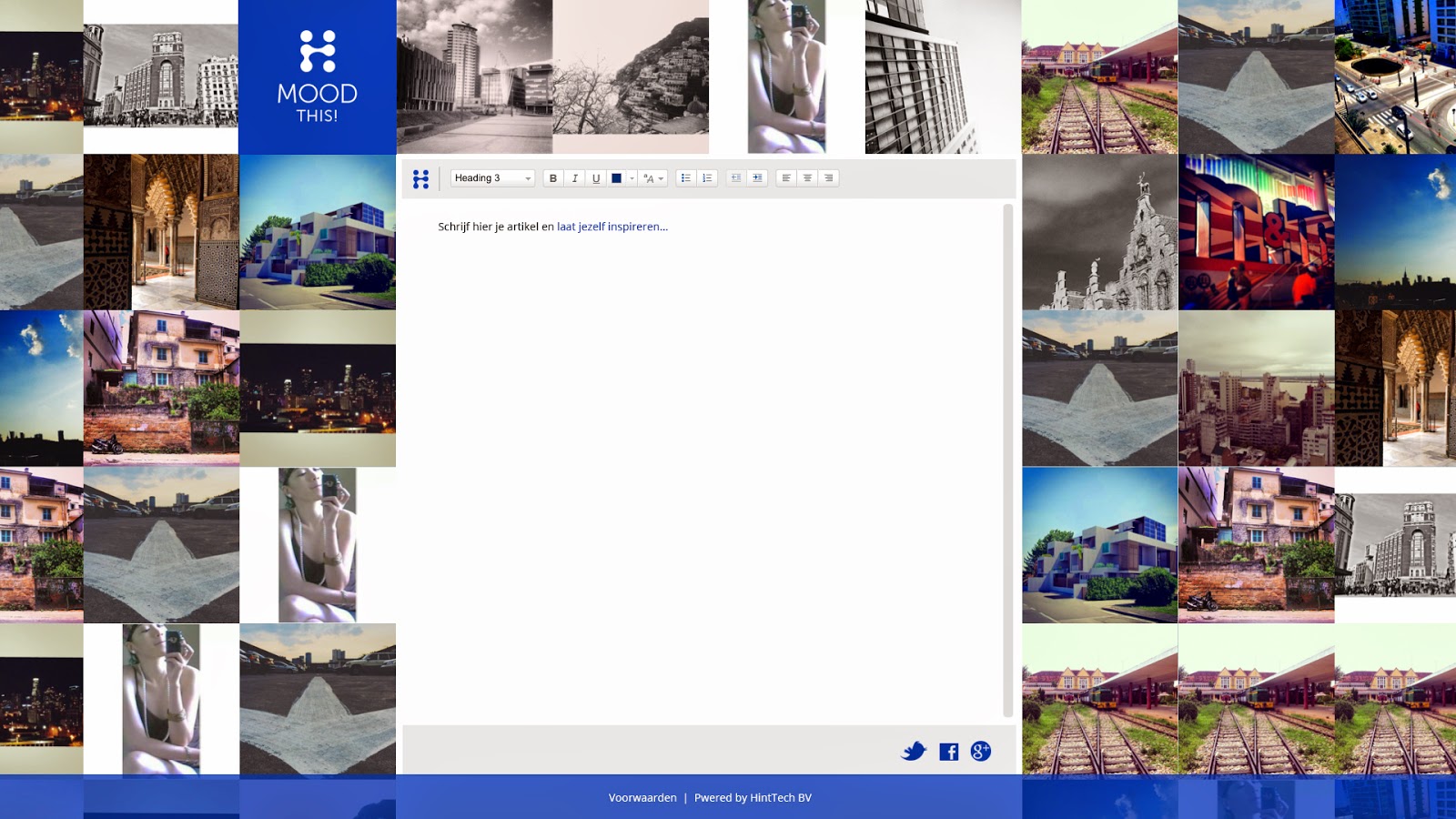
Een inspirerende editor

Binnen HintTech organiseren we regelmatig One Day Product sessies. Tijdens deze One Day Product sessies bedenken en bouwen we binnen één dag een werkend product.

Bij de One Day Product sessie van donderdag 22 mei hebben we gewerkt aan beeldverwerving bij artikelen. Klassieke beeldverwerving is vaak een duur en weinig creatief proces, met een erg statisch eindresultaat. Zou het niet fantastisch zijn als je tekstverwerker je inspireert tijdens het schrijven door interessant beeldmateriaal te tonen?


Met dit idee ging het team uit Dayon, HintTech en Tripitch aan de slag. Irina ontwierp een mooi interface, dat door Martin en Sebastiaan werd gebouwd. Tegelijk gingen Jorg, Fedor en Fabian aan de slag met tekstherkenning en het aanboren van beeldbanken.


Na een lange dag van nadenken, ploeteren, discussiëren en bouwen mag het resultaat er zijn: MOOD THIS!

Probeer het uit! Type een tekst in, en als u een paar seconden niet typt gaat MOOD THIS! op zoek naar een moodboard met beelden en kleuren op basis van woorden uit de tekst. Het resultaat zal vaak verrassend zijn (het is afhankelijk van social media tagging) en hopelijk inspirerend, maar vaak ook gewoon erg leuk.


MOOD THIS! is geïnspireerd door Plastr,  een project van Sebastiaan Hoejenbos en Michiel Peters.

Wednesday, May 21, 2014

Lessons from the New York Times innovation report

A few days ago, the full NY Times innovation report was leaked to the press. The NY Times did a rigorous self-examination, and came to some incredibly important observations on the why and how of true transformation to the digital era.


Reading this document sparked a WOW moment in me. I think it is an absolute must read for anyone dealing with content strategy. Not so much for profound new thoughts, but more for the insight in where NY Times digital performance was good and where it is was poor, affirming that changing a content strategy is hard.
The Nieman Journalism Lab wrote an excellent report on it.

I would like to share a few of the observations and proposals, which I run into in my daily practice:

Create a strategy team

The newsroom is too focused on the daily task to produce the daily newspaper, which leaves insufficient time and focus to assess and implement strategic changes.

I think we all can relate to this problem. It is OK to have a team focused on the daily chores, but somewhere change has to happen. Creating a strategy team is a good idea – as long as it is well-anchored within the standing organisation and has the power to implement change.

Put the Reader first & Grow an audience

The NY Times offers content through all the obvious channels. But by better headlines, better search and better social media skills, NY Times was outperformed, even on their own content. Simple changes such as posting at a time your audience is actually reading, repurposing, repeating, repackaging and personalizing.

The battle for an audience isn’t fought anymore on selling a paper or a website by its front-page: every article has to fight its own battle on the saturated content market.

The report also suggests branching off and seeking audiences in different forms. Hosting events and talking to real customers should be on anybody’s agenda.

Structure to repurpose

The report tells a compelling story on why content needs to be enriched through tagging and structured data.

This reaffirms the choices we made in Newz project: structuring content by location, time (and events), story type and topics (persons and organisations). The NY Times adds to this: timeliness, story threads, story tone and the use of imagery.

I feel that any content-organisation should consider structuring content on some of these base functions.

Overcome the huge cultural change to become ‘Digital First’

The report points out that changing a newsroom from a century-old habit of paper & front-page to ‘Digital First’ is a huge challenge. The cultural change will take new technology savvy people and new managers encouraging cultural change.

The Times created many beautiful digital showcases like “Snow Fall”. But the NY Times built “Snow Fall” and not a “Snow Fall building tool”.


Anyone working difficult markets should be willing to experiment more in presentation formats, accept imperfection, accept failure, measure so you know what succeeds and have the tools ready to expand on success.

Read this!

If you are in any way active in content strategy or news: Please read this report. See that you are not alone in your struggle and gorge on the valuable insights.

Thanks to a Dutch analysis from the Bladendokter that pointed me to the report.